Blog

Continental Partnerships’ll Boost Local Content Development – NCDMB

Please enable cookies.

You are unable to access leadership.ng

Why have I been blocked?

This website is using a security service to protect itself from online attacks. The action you just performed triggered the security solution. There are several actions that could trigger this block including submitting a certain word or phrase, a SQL command or malformed data.

What can I do to resolve this?

You can email the site owner to let them know you were blocked. Please include what you were doing when this page came up and the Cloudflare Ray ID found at the bottom of this page.

Cloudflare Ray ID: 9d06da2eaf18ef98


Your IP:

2607:f298:6:a044::3aa:ff03


Performance & security by Cloudflare

Read More

Westhaven poised for 50,000-metre drill program in B.C.

Westhaven poised for 50,000-metre drill program in B.C.

Westhaven Gold Inc. [WHN-TSXV] has announced the planned start of drilling at the company’s Shovelnose gold and silver project in the Spence Bridge Gold Belt of southern British Columbia. Subject to the outcome of today’s special meeting of Westhaven sharholders to consider a previously announced transaction with Dundee Corp. [DC.A-TSX], the program is expected to be the start of an approximately $20 million, 50,000-metre program of resource definition and exploration drilling planned for Shovelnose in 2026

The announcement comes after Westhaven recently granted Dundee the right to acquire up to a 60% interest in a basket of Westhaven projects located in the Spences Bridge Gold Belt, including the Shovelnose, Prospect Valley, Skoonka Gold and Skoonka North prospects. Dundee agreed to earn the interest by spending $85 million. Dundee is making a commitment to invest at least $30 million within three years of the effective date of the agreement.

On Tuesday, Westhaven were unchanged at 22.5 cents. The shares trade in a 52-week range of 29 cents and 11 cents.

Westhaven has said the Shovelnose Gold Project and broader Spence Bridge Gold Belt could evolve into a multi-deposit, multi-generational gold mining camp in a region of British Columbia with exceptional infrastructure advantages and a long history of mine development.

Dundee’s interest in the projects, when earned, will be held through a newly incorporated subsidiary (JVCo). In addition, Dundee has also agreed to subscribe, on a private placement basis, for 12 million common shares of Westhaven priced at 25 cents each, for gross proceeds of $3.0 million. The financing is expected to close on December 31, 2026.

The agreement calls for an expected 2026 project expenditure of $20 million, money that will fund infill resources and technical drilling at the South Zone gold deposit, targeted exploration drilling at the Shovelnose property, an expanded environmental baseline program and the launch of project engineering studies in support of a pre-feasibility study.

The 2026 drilling plans at Shovelnose are supported by a multi-year notice of work authorization, allowing for 650 drill pads to be completed through January 30, 2029. Westhaven will remain operator of the projects until Dundee earns 50%.

In a press release on March 3, 2025, Westhaven reported the completion of an updated PEA at its 100%-owned 41,634-hectare Shovelnose property, which is located within the prospective Spences Bridge Gold Belt, which borders which borders the Coquihalla Hwy., 30 kilometres south of Merritt, B.C. The company said the PEA outlines a robust, low-cost, rapid pay-back, high-margin, 11.1-year underground gold mining opportunity and is based on updated mineral resources that include contributions from the South, Franz and FMN zones.

The PEA envisages average annual life-of mine gold production of 56,000 ounces.


Read More

Kenya Motorists Rejoice as Fuel Prices Drop Again

Kenya Motorists Rejoice as Fuel Prices Drop Again

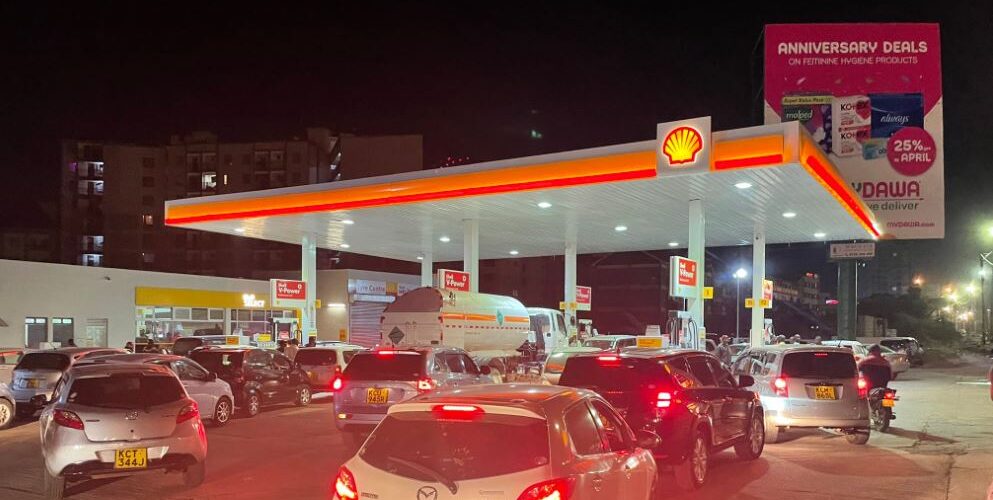
Kenyans are set to benefit from lower fuel prices after the Energy and Petroleum Regulatory Authority announced reductions on Saturday, February 14.

In its latest fuel review, EPRA lowered Super Petrol by Ksh4.24, Diesel by Ksh3.93, and Kerosene by Ksh1.00. The new retail prices will be Ksh178.28 per litre for petrol, Ksh166.54 for diesel, and Ksh152.78 for kerosene. The revised prices will take effect from February 15 and remain valid until March 14.

EPRA confirmed that the prices include the 16 percent Value Added Tax (VAT) in line with the Finance Act 2023 and the Tax Laws (Amendment) Act 2024.

The regulator also noted a decrease in the average landed cost of imported petroleum products. Super Petrol fell by 2.69 percent from Ksh76,288.03 per cubic metre in December 2025 to Ksh74,239.91 in January 2026. Diesel dropped by 6.37 percent from Ksh80,733.36 to Ksh75,587.29 per cubic metre, while kerosene decreased by 1.44 percent from Ksh78,260.16 to Ksh77,135.62 per cubic metre over the same period.

“Currently, Kenya imports all its petroleum product requirements in refined form, and the products are traded in international markets based on a pricing benchmark,” EPRA said.

The regulator added, “Further, the trade of petroleum products in the international markets is denominated in United States dollars, and an exchange rate is applied to convert the dollar to Kenyan shillings during the computation of local pump prices.”

Regional Prices Offer Relief

Motorists in Mombasa will enjoy some of the lowest fuel prices in the country, with Super Petrol at Ksh175.00 per litre, Diesel at Ksh163.26, and Kerosene at Ksh149.49. The city’s position as the main entry point for imported petroleum helps explain the lower prices in Mombasa and other coastal counties.

In the capital, Nairobi, Super Petrol will sell at Ksh178.28 per litre, Diesel at Ksh166.54, and Kerosene at Ksh152.78. Nakuru motorists will pay Ksh177.34 for Super Petrol, Ksh165.95 for Diesel, and Ksh152.21 for Kerosene. In Eldoret, EPRA set prices at Ksh178.15 for Super Petrol, Ksh166.77 for Diesel, and Ksh153.03, reflecting a noticeable drop in fuel costs.

Continued Relief for Motorists

The announcement comes as welcome relief for many Kenyans, particularly motorists who had feared a price hike following reports that new regulatory charges might be introduced.

This reduction marks the second consecutive cut since the start of the year, following a Ksh2.00 price drop in the January–February cycle. With fuel costs easing, Kenyans can expect a modest reprieve at the pumps for the coming month.

Read More

PIA has brought lots of transparency to Nigeria market – TotalEnergies

PIA has brought lots of transparency to Nigeria market – TotalEnergies

Apparently impressed with the current transparency in the oil and gas industry in Nigeria, the Managing Director and Chief Executive, TotalEnergies EP Nigeria Matthieu Bouyer, said the Petroleum Industry Act ( PIA) has helped the company to take and translate resources and de- risk them into bankable and executable projects.

Besides, he said the company has been looking for fast market deals, adding that the current business environment has actually fallen squarely into  what it has been able to do in Nigeria.

Speaking at a panel session titled:” IOCs De- Risking  Investments in Africa Oil and Gas Projects” during the Sub-Saharan Africa International Petroleum Exhibition and Conference (SAIPEC) in Lagos, Bouyer said the company has made huge progress in the last three years.

According to him, the will of Nigeria’s  government through the PIA has made things easy to do business.

He described the transition in Nigeria over the last three years as “phenomenal”, saying the PIA really paved the way to a lot of businesses

Represented by the Executive Director, Strategy Business and Asset Management (SBAM), Abiodun Afolabi, the managing director said that one of the factors, which has brought a lot of transparency in the market, coupled with the will of the government, is the PIA

He said:” I believe there have been a couple of factors that have led to that, one being the PIA, which has brought a lot of transparency in the market. It’s helped to pave the way to a lot of businesses .

“The other has been the will of the government through the PIA in Nigeria by putting in place institutions and regulations that have made it easier for us to do business.”

“And I go by three years because it sort of ties with the new administration that has come into Nigeria that has been very business-minded.”

“What we’ve seen in Nigeria, which sort of translates into how TotalEnergies does business, is that, first of all, there’s the above-ground and the below-ground and the above-ground risk.

“The beauty of Nigeria is that, I think Wood Mackenzie has estimated in Nigeria for us to have resources in the range of 50 billion barrels  and over 200 tcf of gas. So in terms of Nigeria being prolific, subsurface, it’s there, it exists. Above-ground used to be our issue and I’d say we’ve made huge progresses in the last three years through the PIA, through the institutions that have been put in place such as NUPRC in allowing us to be able to take and translate those resources and de-risk them into bankable and executable projects,” he said.

Over the last three years, he added that the company has been able to identify certain projects, which one of them being the Ubeta project, implemented  in 2024.

He said the project fell into the template and  types of projects that was done by capitalizing on existing infrastructure.

“Clearly, over the last three years, we’ve been able to identify certain projects, one of them being the Ubeta project, which we ever in 2024. Which clearly falls into that template and  types of projects which clearly were able to capitalise on existing infrastructure.

“And basically, we’ve been able to translate the resources of over one TCF into a project that will be executed next year, 2027, many it executable and bankable. The current infrastructure  makes it simple for us to look at a resource and off-take it in a short period of time.

He also mentioned IMA project as the second in the same framework, with a resource close to the market and identifiable offtake in a short period of time

“So hopefully we’ll be FID Ima in 2026 with a potential opportunity to get to ready to start up (RFSU) or  first RFSU by 2029. So, this is what is key for us, an environment in which business can be done efficiently with limited bottlenecks,” the managing director said, adding, “that doesn’t mean that we don’t do exploration.”

To de-risk investments, Bouyer stressed the importance of clear and consistent government policies, strong contracts, and well-planned projects. He also emphasized the need for partnerships with indigenous companies to enable faster execution and greater value creation.⁶

He noted that TotalEnergies has taken steps to reduce its environmental footprint in Nigeria, including eliminating routine gas flaring and implementing methane detection sensors. The company is also advancing renewable energy projects, such as a 5-MW solar power plant at OML 58.

He mentioned the recent bid round launched by NUPRC in 2024 as another opportunity the company was able to capitalised on

“This was a clear case in which the process was transparent and with our partners, we were able to execute in a short period of time or we were able to be successful in delivering assets in-country,” he said.

“So long and short, I think what is key for a successful presence in-country is firstly the resources, which is not the issue for us in Nigeria but clearly a transparent framework to do business, which is the case that we’re seeing in Nigeria today,  which is allowing us to continue to extend and to thrive in this environment.

Over the last years, the CEO said the company has been able to close a number of deals , assuring that it would continue to earmark opportunities  in-country,  believing they will put TotalEnergies in lead for the next years to come.

On whether gas is seen as a transition fuel, he said the market remains fundamental, adding that there has to be an offtake.

‘We are in a prolific zone. And for us, there is more gas in Nigeria than there is oil. So clearly, it is an opportunity. Now, how do we capitalise on that opportunity? It is clearly by developing the market and the infrastructure,” he said

For easy projects, he said the elements of market and infrastructure exist, adding that where they  don’t exist,  there is a need to develop them.

“In many cases, we do. If you take the example of the ECOP, where there isn’t a solution, we develop a solution, we develop a pipeline.

” In Nigeria, you need to develop that infrastructure, you need to develop the mode in which we share infrastructure. Ultimately, what makes our projects robust is the cost to bring them to market. “We talked about capital being agnostic. but to some degree, it is limited.

“There is one thing that we don’t predict in my company, we don’t predict the oil price. So the only way to ensure that your project is robust is that, at the worst oil prices, it still is viable.

“For it to be viable,  we need to ensure that we develop the capacity that we can do more in-country than externally, ” he said.

He described gas as the future, adding that the transition is a plus for Africa.

According to him, “the way to ensure that  we’re in the game is that we make our projects viable, I mean by the markets,  and by the infrastructure that ultimately brings down the cost of bringing it to market.”

Read More

Argentina’s Shale Boom Is Rewriting South America’s Energy Map

Argentina’s Shale Boom Is Rewriting South America’s Energy Map

The massive unconventional oil boom underway in Argentina continues to gain momentum. During late 2024, Argentina, which is South America’s second largest economy after Brazil, overtook Colombia to become the continent’s fourth largest oil producer. The surge in petroleum revenues, coupled with President Javier Mieli’s economic reforms, is a boon for one of the world’s most unstable and crisis-riven economies. There are signs of strong production growth ahead with shale oil and gas output expanding at a solid clip. 

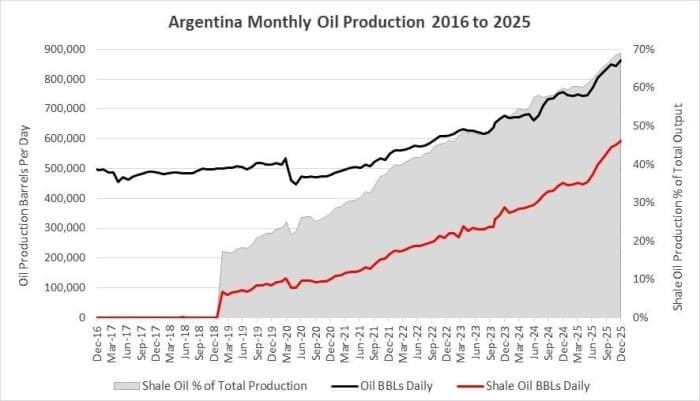
Government data shows that for December 2025, Argentina pumped a record of 861,380 barrels of crude oil per day. This was 2% greater than a month earlier and an impressive 14% higher year over year. As the chart illustrates, that solid number is nearly double the 494,721 barrels per day lifted for the same period a decade ago.

Argentina
Source: Argentina Ministry of Economy.

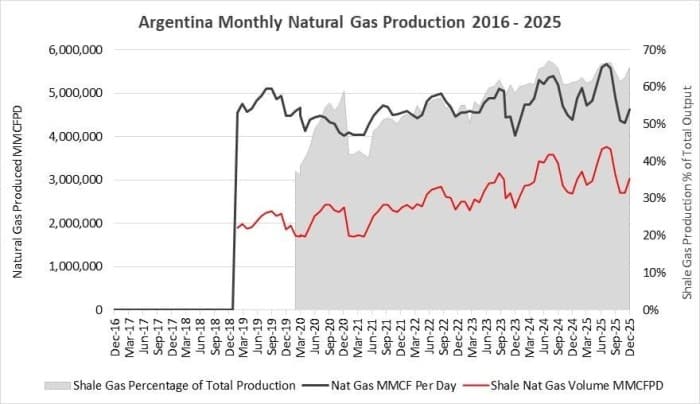
Natural gas production has also grown significantly over the last decade. December 2025 output of 4.6 billion cubic feet per day was 7.4% higher than a month prior and 5.7% greater than the same month a year earlier, although that number is still below recent historical highs. As the chart below shows, December 2025 natural gas output is well below the record monthly high of 5.7 billion cubic feet per day reported for July 2025. 

Argentina
Source: Argentina Ministry of Economy.

It is rapidly growing shale oil and gas production, which is responsible for the impressive expansion of Argentina’s hydrocarbon output. The successful exploitation of the 8.6-million-acre Vaca Muerta shale formation is responsible for this strong growth in hydrocarbon output, particularly with production from Argentina’s higher-cost mature oil fields declining

The rapid growth of unconventional hydrocarbon production in Argentina is occurring despite the naysayers asserting a lack of investment, infrastructure, and expertise is curbing production growth. Government data shows December 2025 shale oil production hit an all-time high of 593,488 barrels per day, with it making up a record 69% of all petroleum lifted. That was 0.6% greater than a month prior and 31% higher year over year, while being more than several thousand times greater than a decade earlier. 

A similar phenomenon is occurring with shale gas. For December 2025, Argentina’s shale gas production of 3 billion cubic feet per day represented a 12% increase when compared to both a month and a year earlier. Although it is 18% lower than the all-time high of just under 3.8 billion cubic feet reported for July 2025. Nonetheless, December 2025 shale gas output was still responsible for 65% of Argentina’s total natural gas production.

There are signs of significant shale gas production growth ahead, particularly with the Vaca Muerta now the engine room for Argentina’s fossil fuel output. It is Argentina’s national oil company, YPF, which is the leading developer and producer of hydrocarbons in the Vaca Muerta. The driller is 51% owned by Argentina’s state and federal governments after it was nationalized by President Cristina Fernández de Kirchner in April 2012. YPF plans to become a pure unconventional oil and gas company by the end of the decade.

The national oil company for December 2025 lifted 384,397 barrels per day, representing 55% of Argentina’s total petroleum production for that month. Of that total petroleum output, 86%, or barrels per day, was shale oil pumped from the Vaca Muerta. YPF’s natural gas output for that period was 947,191 million cubic feet per day, which represents 20% of Argentina’s total production of the fossil fuel for December 2025. Shale gas comprised 80% of YPF’s total natural gas production for the period, underscoring how the company is rapidly moving to a pure play shale oil and gas driller.

YPF expects production to grow at a solid clip. Not only is the development of the company’s Vaca Muerta acreage at an early stage of development but the integrated energy major plans to spend nearly $36 billion between 2025 and 2030. According to the company, drilling will peak in 2029 with 32 active drill rigs. This will drive higher production with YPF estimating total hydrocarbon output of 1 million barrels of oil equivalent per day, nearly double the 553,009 barrels produced during December 2025. That will be 47.5% weighted to crude oil, with the remainder comprised of natural gas (440,000 barrels) and natural gas liquids (75,000 barrels).

Other energy companies are investing heavily in the Vaca Muerta. Hydrocarbon investment for 2026 is expected to reach $11 billion, a 17% increase over $9.4 billion for 2025. Most of that capital will be directed toward the Vaca Muerta shale play. The hydrocarbon-rich geological formation, which contains an estimated 16 billion barrels of shale oil and 308 trillion cubic feet of shale gas, is attracting considerable attention from Big Oil. Supermajor Shell, which recently dismissed speculation that the company was planning to divest its Vaca Muerta assets, committed to spending $700 million on the shale play during 2026.

Colombia-headquartered independent oil and gas producer GeoPark recently secured $50 million of financing to develop acreage in the Vaca Muerta. The company previously announced plans to invest in developing the Loma Jarillosa Este and Puesto Silva Oeste Blocks, which were purchased from Pluspetrol during September 2025. This signals the entry of another intermediate exploration and production company in the Vaca Muerta, underscoring the shale play’s solid economics, with the average breakeven price as low as $36 per barrel, which makes it attractive for smaller drillers.

The rapid development of the Vaca Muerta not only reversed Argentina’s crippling energy deficit, which hit an all-time high of $7 billion during 2013, but has made the crisis-prone country a net energy exporter. That, along with President Javier Milei’s economic shock therapy, where fiscal spending was slashed, and the currency stabilized through a managed floating rate, is delivering a massive economic dividend for Argentina. The president’s plans to reduce regulation while removing strict currency and capital controls will drive further foreign investment, particularly for the Vaca Muerta, which is the engine room of Argentina’s hydrocarbon sector.

By Matthew Smith for Oilprice.com

More Top Reads From Oilprice.com


Read More

‎Oil prices decline, set for second straight weekly drop

‎Oil prices decline, set for second straight weekly drop

Oil prices decline, set for second straight weekly drop

Oil drilling rigs


Oil prices fell in Friday trading and were set for a second straight weekly decline as market concerns over a potential US–Iran conflict disrupting supplies continued to ease.

April Brent crude futures slipped 0.15%, or 10 cents, to $67.42 a barrel at 09:23 am KSA time. Prices are on track to fall about 0.8% this week.

US WTI crude futures for March dropped 0.25%, or 15 cents, to $62.69 a barrel. Weekly losses are expected to exceed 1%.

Markets are awaiting later Friday data from Baker Hughes on the US oil and gas rig count for fresh signals on supply trends.

Read More

NNPC, Edo Plan 10,000bpd Refinery, Target Completion in 36 Months

NNPC, Edo Plan 10,000bpd Refinery, Target Completion in 36 Months

The Nigerian National Petroleum Company Limited and the Edo State Government have agreed to develop a 10,000-barrels-per-day condensate refinery, with a completion target of 24 to 36 months.

According to the disclosure, the proposed facility will be located across Oredo and Orhionmwon local government areas. The pitch is familiar but still important: jobs during construction, stronger industrial activity, and improved energy security for the surrounding region.

What makes the details worth watching are the output expectations. When operational, the project is projected to produce around 20 truckloads of Premium Motor Spirit daily and an additional 10 truckloads of Automotive Gas Oil per day. Those figures are framed as supply relief for Edo and nearby states, potentially easing constraints in the wider South-South market.

But the success of projects like this often hinges on execution discipline: funding clarity, governance structure, feedstock reliability, and evacuation logistics. The “36 months” promise is ambitious in a sector where delays can come from procurement bottlenecks, FX pressure, contractor disputes, and regulatory friction.

If it works, the impact can be meaningful at the margins. A 10,000bpd facility won’t rewrite national supply alone, but it can reduce regional dependence on long-haul supply chains and create a more resilient distribution network, especially when paired with storage and transport planning.

Nigeria is moving toward a refining mix of large flagship plants plus smaller, regionally located facilities. That diversification can reduce single-point failures. But only if timelines, transparency, and operational readiness match the optimism of the announcement.

Read More

Tengiz Munai Oil & Gas is available for supplying and trading of different kinds of Petroleum Products, Petrochemicals and Minerals. Tengiz and it subsidiaries has over 10 years of brilliant background in the field of international trade and is fully operative in Europe and Asia.

  • +79 672 053 438
    +79 267 742 645

  • info@tengismunaigas.com

  • Almaty, Bostandyk District, Nursultan Nazarbayev Avenue, 187

  • Mo-Fri: 8am - 6pm
    Sat: 10am - 4pm
    Sun: of